A 2-Bedroom Apartment in Central Sydney for $229,000. What’s the Catch?
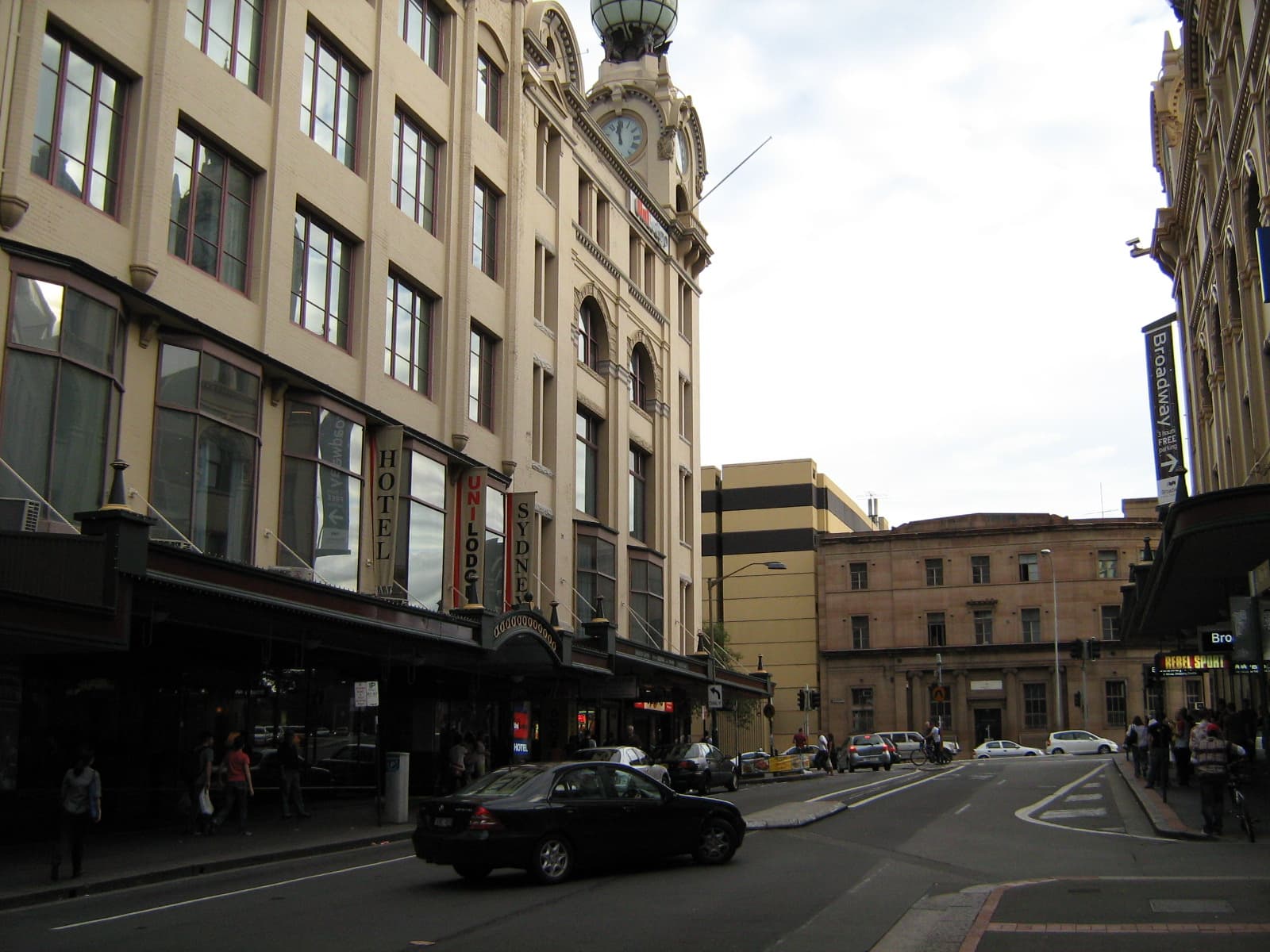
Photo by Orderinchaos on Wikimedia Commons
A two-bedroom apartment in Ultimo — walking distance to two universities, a major shopping centre, and Central Station — listed for $229,000. In a suburb where the median unit price is $750,000. That's not a typo.
The building is 185–211 Broadway, formerly UniLodge on Broadway. It's a heritage Grace Brothers department store converted into 586 student apartments. And behind the eye-catching price is one of the most extraordinary strata disasters in NSW history: a committee coup, over $1 million in legal fees, a compulsory strata manager, levies that jumped from $1,000 to $11,000 per quarter, and units that have lost half their value in a decade.
This is the story of how it all went wrong — and what every apartment buyer can learn from it.
View this building on StrataChecks
SP 54026 — 613 lots, 8 tribunal cases, dispute history, sale prices, and more.
613
Strata lots
$159K
Building median
$750K
Suburb median
−79%
Price gap
The building: a department store reborn
The Grace Brothers department store on Broadway was one of Sydney's retail landmarks. Founded in 1885, the store grew from a small drapery shop into a sprawling complex that dominated the Broadway streetscape for over a century. When Myer took over Grace Bros in the early 1990s, the Broadway store was vacated.
In 1998, the building was converted. Part became the Broadway Shopping Centre. Part became 586 student accommodation apartments managed by UniLodge, plus 27 commercial shopfronts — 613 strata lots in total, registered as SP 54026.
The apartments are tiny. Studios start at around 13–17 square metres. Loft apartments run 28–31 sqm. What's listed as a “2-bedroom” is typically a loft with a mezzanine counted as the second bedroom. But the location is undeniable — it's directly across from the University of Sydney and a short walk to UTS, with a heated pool, gym, and 24-hour security.
For years, the formula worked. Investors bought units for $170,000–$200,000, leased them to students through UniLodge, and collected modest rental income. Then everything fell apart.
Catch #1: Students only
The first catch is structural. Only full-time students can live in these apartments. This is locked into the management arrangements via lease agreements with Sydney Campus Apartments Pty Ltd, a UniLodge subsidiary. You can't move in yourself. You can't rent to a non-student.
This restriction eliminates owner-occupiers from the buyer pool entirely. Your only market is investors — and investors buying student accommodation price in a lot of risk. Most banks cap lending at 60% LVR for these properties, if they'll finance them at all.
Why this matters
When you can't live in it and banks won't fully finance it, you've eliminated two of the three forces that support apartment prices: owner-occupier demand and leveraged buying power. Only cash investors remain — and they demand steep discounts.
Catch #2: A heritage awning and a safety hazard
In 2015, the City of Sydney flagged the heritage awning at the front of the building as a public safety hazard. The council issued a notice of intention to order its repair, warning of likely “catastrophic failure.”
The strata committee began planning repairs. Contractors were engaged. Owners were levied. The building was on track to fix the problem.
Then the politics started.
Catch #3: The strata committee coup
At the December 2018 AGM, a faction of lot owners staged what NCAT would later describe as a leadership coup. They voted off the existing strata committee, cancelled the repair contractors, and refused to accept proxy votes from the hundreds of lot owners whose apartments were managed by UniLodge.
The new committee, led by the principal of a real estate agency next door to the UniLodge entrance, refused to proceed with the awning repairs. This triggered a cascade of legal battles at both NCAT and the Supreme Court.
Timeline of the legal war
City of Sydney flags heritage awning as safety hazard, warns of “catastrophic failure.”
Strata committee plans repairs, engages contractors. At December 2018 AGM, a faction stages a leadership coup, cancels repairs, refuses to accept proxy votes.
UniLodge files at NCAT under s237 of the Strata Schemes Management Act for a compulsory strata manager, arguing the scheme is dysfunctional.
The owners corporation spends over $1 million on legal fees resisting the compulsory manager appointment. Multiple hearings at NCAT and appeals to the Supreme Court.
NCAT appoints Bright & Duggan as compulsory strata manager for two years. The coup-era resolutions are invalidated. The owners corporation is ordered to pay UniLodge's legal costs.
Compulsory manager begins $20M+ repair programme. Levies jump from $1,000 to $11,000 per quarter. Owners panic. 40+ units are listed for sale simultaneously.
UniLodge no longer manages the building. Units are now individually managed by private owners and real estate agents. The building remains in recovery.
The NCAT principal member's ruling was blunt. The main dysfunction was the “improper refusal to accept as valid, proxy and corporate owner nominee forms submitted prior to numerous general meetings, disenfranchising hundreds of lot owners.”
In other words: a small faction had seized control of a 613-lot building by refusing to count the votes of the majority.
Catch #4: The levy explosion
Once the compulsory manager was appointed and the true scale of deferred maintenance became clear, the bill came due. The building needed an estimated $20 million or more in repairs. Combined with the $1M+ in legal fees the owners corporation had already spent fighting the appointment, levies had to increase dramatically.
Quarterly levies: $1,000 → $11,000
A 10x increase, sustained for two years. That's $44,000 per year in levies on an apartment worth $170,000. Over two years: roughly $80,000 per unit — nearly half the asset's value.
For investors who had bought studios for $170K expecting modest rental returns, this was devastating. The annual rental income on a student studio doesn't come close to covering $44,000 in levies alone — before mortgage payments, rates, insurance, or maintenance.
A group of 178 owners formed an action group. They wrote to the Minister, to Bright & Duggan, and to NCAT. None intervened. They planned a march from Sydney Town Hall to Parliament House in March 2022 to deliver a petition to the Premier.
By mid-2022, over 40 units were listed for sale simultaneously. Few were selling.
What the sale prices show
The price data tells the story of a building in freefall. Units that originally sold for $170,000–$200,000 in the early 2010s have seen no capital growth — and many have gone backwards.
Recent sales at 185–211 Broadway (2025)
| Unit | Type | Sale price | Date |
|---|---|---|---|
| 2109/185 Broadway | 1 bed | $196,000 | Oct 2025 |
| 2140/185 Broadway | 1 bed | $210,000 | Oct 2025 |
| 2009/185 Broadway | 1 bed | $145,000 | Sep 2025 |
| 2099/185 Broadway | 1 bed | $145,000 | Apr 2025 |
| 4066/185 Broadway | 1 bed | $170,000 | 2024 |
Source: NSW Valuer General Property Sales Information.
Some units have sold for as low as $116,000–$120,000. The building median is $159,000, compared to an Ultimo suburb median of $750,000. That's a 79% discount — the second-worst price performance of any building in our analysis of dispute buildings across NSW.
185–211 Broadway vs. Ultimo
Based on residential sales (2020–2025) from the NSW Valuer General dataset.
8 tribunal cases and counting
In our database of 2,004 published NCAT and Supreme Court decisions involving strata schemes, 185–211 Broadway has 8 published cases — tying it for the joint second-most litigated building in NSW. Only two buildings have more: one in Ultimo (9 cases) and one in The Entrance (9 cases).
As we found in our analysis of buildings that can't stay out of court, repeat litigation is one of the strongest predictors of ongoing dysfunction. Buildings with 5+ cases are chronic. This one has 8.
A pattern of compounding problems
The tribunal cases span governance disputes, proxy vote validity, compulsory manager appointments, and cost order applications. This isn't a building that had one bad year — it's a building where dysfunction became structural, each unresolved problem feeding the next.
The five catches, compounded
No single factor explains the 79% price discount. It's the combination that makes 185–211 Broadway a perfect storm:
Student-only occupancy restriction
No owner-occupiers allowed. Buyer pool limited to cash investors. Banks won't fully finance the purchase.
Tiny apartments
Studios as small as 13 sqm. “Two-bedroom” lofts at 28–31 sqm. These are purpose-built student accommodation, not conventional apartments.
Governance collapse
A strata committee coup, years of blocked repairs, $1M+ in wasted legal fees, and a compulsory strata manager appointed by the tribunal.
Levy shock
Levies increased 10x to fund $20M+ in deferred repairs and legal costs. At $44,000 per year, the levies alone exceeded most units' rental income.
Zero capital growth
Units sold for $170K a decade ago are now selling for $145K–$210K. After accounting for levies and lost income, the total loss for many owners is catastrophic.
Each problem amplifies the others. The student-only restriction limits your exit options. The tiny sizes limit price comparisons. The governance collapse created the repair bill. The repair bill caused the levy explosion. The levy explosion caused the price collapse. And the price collapse means you can't sell without taking a massive loss.
What to check before buying a “bargain” apartment
The $229,000 listing sounds like a deal of a lifetime. But every red flag was there before the price collapsed — if you knew where to look. Here's what to check before buying any apartment that seems too cheap:
Check for occupancy restrictions
Can anyone live in the apartment, or is occupancy restricted to students, over-55s, or other groups? Restrictions kill your resale market. Read the strata by-laws and any management agreements — not just the listing description.
Check the strata levies — including special levies
Look at the current quarterly levies and any special levies that have been passed or are under discussion. A building with a $20M repair bill will eventually need to levy for it. If the levies seem artificially low for the building's age and size, ask why.
Check the tribunal history
A single dispute about a pet by-law is very different from 8 cases over proxy vote fraud and compulsory management. The number, type, and pattern of disputes matters. Our research shows that building defect disputes are associated with price discounts of 50–80%.
Check whether a compulsory manager has been appointed
A compulsory strata manager is only appointed when NCAT finds the scheme is dysfunctional. It's a nuclear option. If the building has had one — or currently has one — understand why, and check whether the underlying problems have been resolved.
Check bank lending policies
If banks won't lend at standard LVR, there's a reason. Student accommodation, serviced apartments, and units under a certain size (typically 40–50 sqm) face lending restrictions. This limits your buyer pool when you sell.
This building isn't unique
185–211 Broadway is an extreme case, but the pattern is common. In our analysis of dispute buildings across NSW, we found 21 buildings trading at more than 50% below their suburb median. They share common features: large lot counts, inner-city locations, and construction defect or governance disputes.
Worst-performing dispute buildings in NSW
| Address | Suburb | Lots | Building | Suburb | Gap |
|---|---|---|---|---|---|
| 185–211 Broadway | Ultimo | 613 | $159K | $750K | −79% |
| 1–5 Bourke St | Mascot | 141 | $223K | $808K | −72% |
| 10 Brown St | Chatswood | 169 | $395K | $1.16M | −66% |
| 13 Waine St | Surry Hills | 177 | $359K | $952K | −62% |
| 243–271 Pyrmont St | Pyrmont | 563 | $516K | $1.26M | −59% |
Based on 475 dispute buildings with 3+ residential sales (2020–2025). Read the full analysis →
The lesson from 185–211 Broadway isn't “never buy a cheap apartment.” It's that the reason it's cheap is always worth more than the discount. A 79% discount sounds like a bargain until you realise the levies alone can cost more than the apartment is worth.
Sources
- Commercial Real Estate — “Strata stoush at iconic Broadway building sees more than $1 million in legal fees spent”
- Holding Redlich — “Compulsory strata management and strata scheme dysfunction — recent trends”
- NSW Valuer General — Property Sales Information (4.4M records)
- NSW Caselaw — NCAT and Supreme Court strata decisions (2,004 decisions)
- NSW Fair Trading — Strata Hub open dataset (88,069 plans)
- Dictionary of Sydney — Grace Brothers
Check any building's strata history before you buy
StrataChecks shows tribunal cases, levy trends, building age, and sale prices for any strata plan in NSW. Don't find out about the catches after settlement.
Search a strata plan →Upload a strata report.
Get a plain-English risk breakdown in 60 seconds. Free, no sign-up.